


Does Creatine Cause Hair Loss?
Reviewed by Dr Salvar Björnsson | Written by Our Editorial Team | Published 20 March 2026
If you’ve seen headlines claiming creatine causes hair loss, you’re not alone. The concern traces back to a single 2009 study on rugby players that found a spike in DHT levels. But here’s the thing: that study never measured hair loss, and no research since has confirmed the link. The evidence, frankly, is thin.
The 2009 South African Rugby Study
Almost every article about creatine and hair loss points to the same piece of research. In 2009, van der Merwe and colleagues published a study in the Clinical Journal of Sport Medicine that tracked 20 college-aged rugby players over three weeks. The participants took 25g of creatine monohydrate daily for seven days (the loading phase), then 5g daily for 14 days (maintenance).
The results showed DHT levels jumped by 56% during loading and stayed 40% above baseline during maintenance. That’s a real hormonal shift. But — and this matters — the study did not measure hair loss, hair density, or follicle miniaturisation at any point. The researchers weren’t studying hair at all. They were looking at hormone ratios in athletes.
| Metric | Loading Phase (Day 1-7) | Maintenance Phase (Day 8-21) |
|---|---|---|
| Creatine dose | 25g/day | 5g/day |
| DHT increase | +56% above baseline | +40% above baseline |
| Testosterone change | No significant change | No significant change |
| Sample size | 20 male rugby players | |
| Hair loss measured? | No | |
According to van der Merwe et al. (2009), the DHT:testosterone ratio increased significantly. But a single study with 20 participants and no replication is not strong evidence by any scientific standard. It’s a starting point, not a conclusion.
What DHT Actually Does to Your Hair
DHT (dihydrotestosterone) is the primary androgen responsible for miniaturising hair follicles in people with androgenetic alopecia. It binds to receptors in the hair follicle, gradually shrinking it until it can no longer produce visible hair. That process — follicle miniaturisation — is what causes the receding hairline and crown thinning pattern most men recognise.
But here’s what’s often misunderstood: DHT is not a problem for everyone. Your follicles need to be genetically sensitive to DHT for it to cause damage. Plenty of men have high DHT levels and a full head of hair. Others have relatively normal DHT levels and still experience significant thinning. The genetic component — specifically variants in the androgen receptor gene — determines whether your follicles respond to DHT by shrinking.
So even if creatine does raise DHT (and the evidence for that is limited), it won’t affect your hair unless your follicles are already vulnerable. If you’re noticing early signs of hair thinning in your 20s, genetics are almost certainly the main driver — not your supplement stack.
What Other Research Says
The van der Merwe study hasn’t been replicated. That alone should temper any strong claims. But we do have other research that paints a different picture.
According to a 2021 meta-analysis by Antonio et al., published in the Journal of the International Society of Sports Nutrition, a review of 12 studies found no statistically significant effect of creatine supplementation on total testosterone or free testosterone levels. While not all studies specifically measured DHT, the overall hormonal profile didn’t shift in a meaningful way.
According to the International Society of Sports Nutrition (ISSN), creatine monohydrate is one of the most extensively studied sports supplements available, with a strong safety profile across hundreds of trials. Their position stand makes no mention of hair loss as a documented side effect.
| Study | Year | Participants | DHT Finding | Hair Loss Measured? |
|---|---|---|---|---|
| Van der Merwe et al. | 2009 | 20 rugby players | +56% (loading), +40% (maintenance) | No |
| Antonio et al. (meta-analysis) | 2021 | 12 studies reviewed | No significant testosterone/DHT change | No |
| Kreider et al. (ISSN Position Stand) | 2017 | Comprehensive review | Not specifically measured | No — not listed as side effect |
| Rawson & Volek | 2003 | Review of clinical data | No hormonal disruption observed | No |
The short version: one small study found a DHT increase. A much larger body of evidence doesn’t support it. And zero studies have ever directly linked creatine supplementation to measurable hair loss.
Factors That Actually Drive Hair Loss
If you’re losing hair and also happen to take creatine, it’s natural to wonder if there’s a connection. But correlation isn’t causation, and there are far more likely explanations. Creatine is not a proven cause of hair loss. Here’s what is.
| Factor | Evidence Level | How It Causes Hair Loss |
|---|---|---|
| Androgenetic alopecia (genetics) | Very strong | DHT-sensitive follicles shrink over time; affects ~50% of men by age 50 |
| Chronic stress | Strong | Pushes follicles into telogen (resting) phase prematurely — learn more about stress hair loss |
| Rapid weight loss / calorie restriction | Strong | Nutritional deficiencies trigger telogen effluvium — read about weight loss and hair loss |
| Iron and vitamin D deficiency | Moderate-strong | Follicles need iron for cell division; low vitamin D linked to alopecia areata |
| Overtraining / physical stress | Moderate | Cortisol spikes from extreme exercise can disrupt hair growth cycles |
| Creatine supplementation | Weak (1 study) | Theoretical only — may raise DHT, but no direct hair loss evidence exists |
Many men who take creatine are also training intensely, cutting weight, dealing with work stress, or restricting calories. Any of these can trigger noticeable shedding. Blaming creatine is easy. The reality is usually more complicated.
Should You Stop Taking Creatine?
Probably not — at least not based on the hair loss concern alone. Creatine monohydrate has decades of safety data behind it. It improves strength, power output, and recovery. For most people, it’s one of the few supplements that genuinely works.
If you’re genetically predisposed to male pattern baldness, could elevated DHT from creatine theoretically speed things up? In principle, maybe. But we don’t have evidence it actually happens. And stopping creatine won’t reverse androgenetic alopecia — that’s driven by your genetics, not your supplement routine.
What makes more sense is addressing the known causes. If you’re noticing thinning, get a proper assessment. Women experiencing thinning hairlines face a similar challenge — the causes are usually hormonal or genetic, and identifying the right one early makes treatment far more effective.
If stopping creatine gives you peace of mind, that’s your call. But don’t expect it to solve a hair loss problem that’s almost certainly been building for years.
When to See a Hair Specialist
Here’s the honest answer: if you’re Googling “does creatine cause hair loss,” you’re probably already worried about your hair. And that’s actually a good sign — catching hair loss early gives you the most options.
You should consider seeing a specialist if you’re noticing any of these:
- A receding hairline that’s moved back over the past 6-12 months
- Visible thinning at the crown or temples
- More hair than usual on your pillow, in the shower, or on your hands after styling
- A widening part line (particularly relevant for women noticing thinning)
A hair specialist can run a proper assessment — looking at your scalp under magnification, checking for miniaturisation patterns, and reviewing your medical history. That tells you far more than any internet article about creatine ever could.
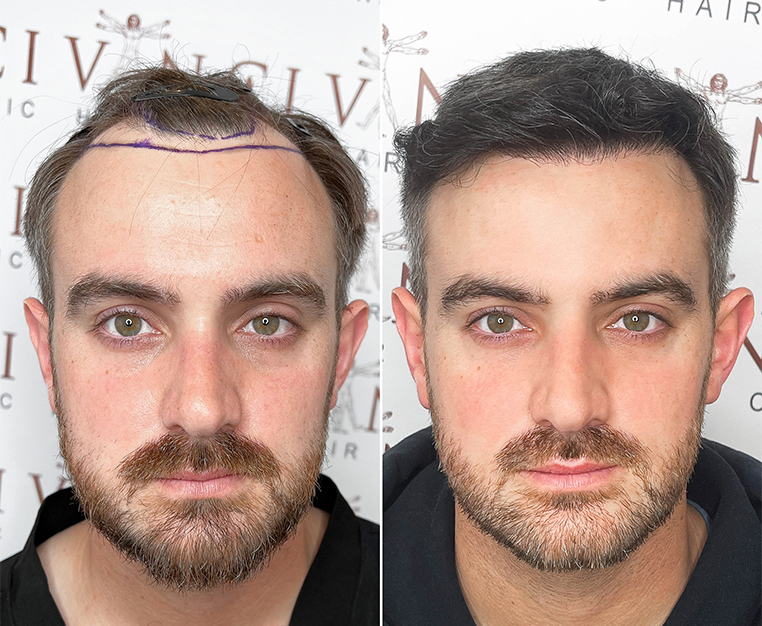
Concerned about your hair? Vinci Hair Clinic offers free consultations to assess your hair loss and recommend the right treatment path. Whether it’s early-stage thinning or more advanced loss, getting a professional opinion early makes a real difference. Book your free consultation or explore our before and after results to see what’s possible.
Frequently Asked Questions
Does creatine directly cause hair loss?
There is no direct evidence that creatine causes hair loss. The concern stems from a single 2009 study on rugby players that found creatine supplementation increased DHT levels by 56%. However, this study has never been replicated, and no research has measured actual hair loss in creatine users. If you’re genetically predisposed to androgenetic alopecia, elevated DHT could theoretically accelerate thinning, but this remains unproven.
What did the 2009 creatine study actually find?
The 2009 study by van der Merwe and colleagues, published in the Clinical Journal of Sport Medicine, found that 20 college-aged rugby players who took creatine monohydrate for 21 days experienced a 56% increase in DHT during the loading phase and a 40% increase during the maintenance phase. The study did not measure hair loss or hair follicle health at any point.
Should I stop taking creatine if my hair is thinning?
Stopping creatine may not make any difference to your hair. Hair thinning in your 20s and 30s is overwhelmingly caused by androgenetic alopecia, which is genetic. If you’re concerned, consult a hair specialist who can assess your hair loss pattern and determine the actual cause before you change your supplement routine.
Does creatine increase DHT levels?
One study found that creatine increased DHT levels by 56% during a loading phase. However, a 2021 meta-analysis of 12 studies by Antonio et al. found no statistically significant effect of creatine supplementation on testosterone or DHT. The evidence is mixed, and a single study isn’t enough to draw firm conclusions.
What actually causes hair loss in men who take creatine?
The most common cause of hair loss in young men is androgenetic alopecia (male pattern baldness), which is driven by genetics and hormone sensitivity in hair follicles. Other contributing factors include stress, nutritional deficiencies, rapid weight loss, and intense training routines. Creatine use often coincides with heavy gym training, which can itself contribute to physical stress on the body.


 UK Store