


Most patients need between 1,000 and 4,000 grafts for a hair transplant, though the precise number depends on the extent of hair loss, the density of the donor area at the back and sides of the scalp, and the coverage goal the patient wants to achieve. There is no universal answer, because no two scalps are the same. What matters is an accurate, individually calibrated assessment carried out by a qualified specialist before any procedure is planned.
Why Graft Planning Is the Most Important Step in Hair Restoration
The number of grafts determines almost everything else about a hair transplant: the cost, the length of the procedure, the design of the hairline, and the density of the result. Get it wrong in either direction and the outcome suffers. Too few grafts and the coverage looks thin or patchy. Too many extracted from the donor zone and the back of the scalp may look depleted, or the patient may not have enough donor hair left for future sessions if their hair loss continues to progress.
Hair loss is also not static. A 30-year-old presenting with a Norwood Scale grade III pattern may well progress to a grade V or VI over the following decade. A responsible graft plan accounts for that trajectory, not just the current picture. This means the surgeon and trichologist must assess donor density, hair calibre, scalp laxity, miniaturisation patterns, and the likely course of androgenetic alopecia before arriving at a recommendation.
The distinction between follicular units and individual hairs matters too. A single graft contains a follicular unit, which may hold one, two, three, or even four individual hairs. A patient with naturally coarser or denser hair follicles may achieve excellent coverage with fewer grafts than a patient with finer hair. This is why the graft count quoted at consultation can differ significantly from what appears on a clinic’s website or what a friend received.
[What is a hair transplant graft?]
Vinci Hair Clinic’s Approach to Graft Planning
Vinci Hair Clinic has been carrying out hair restoration since 2006 and has treated more than 100,000 patients across more than 30 clinics worldwide, including its Harley Street headquarters in London. That scale of clinical experience has shaped a planning methodology that is considerably more detailed than a visual inspection and a rough estimate.
At Vinci, the pre-procedure assessment is conducted by a multidisciplinary team that includes trichologists, dermatologists, and hair transplant surgeons. The scalp is examined under magnification to measure donor density in follicular units per square centimetre, to assess the degree of miniaturisation across the recipient zone, and to map any existing hair that should be preserved rather than transplanted around. Crucially, the consultation also looks ahead, modelling how the patient’s hair loss pattern is likely to develop and reserving adequate donor capacity for any future sessions that may be needed.
Vinci is the founder and global pioneer of Micro Scalp Pigmentation (MSP), a scalp-level treatment that complements hair transplant planning by allowing clinicians to consider a combined approach where appropriate. The clinic is also the pioneer of Long Hair FUE and No-Shave FUE, techniques that have expanded the range of patients who can be assessed and treated without some of the visual disruption of traditional harvesting methods. These technical capabilities mean that Vinci’s graft planning is not constrained to a single technique; the recommendation is shaped by the patient’s anatomy and goals, not by what the clinic happens to offer.
[Vinci Hair Transplant Techniques Explained]
What the Evidence Says About Graft Numbers and Outcomes
The relationship between graft count and aesthetic result is well documented in the peer-reviewed literature. Studies consistently show that a minimum density of around 25 to 30 follicular units per square centimetre in the recipient area is needed to produce a result that looks natural at social distance. In areas such as the frontal hairline and temples, where the visual impact is greatest, that density may need to be higher.
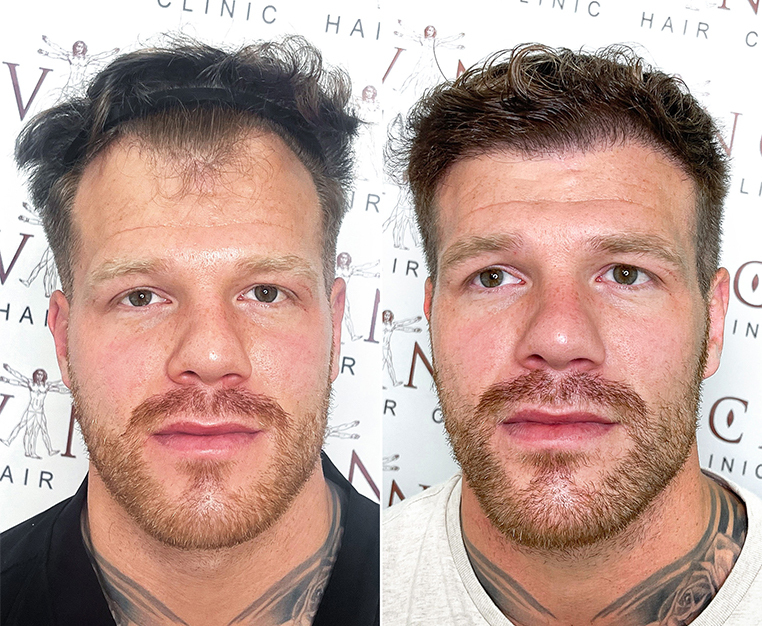
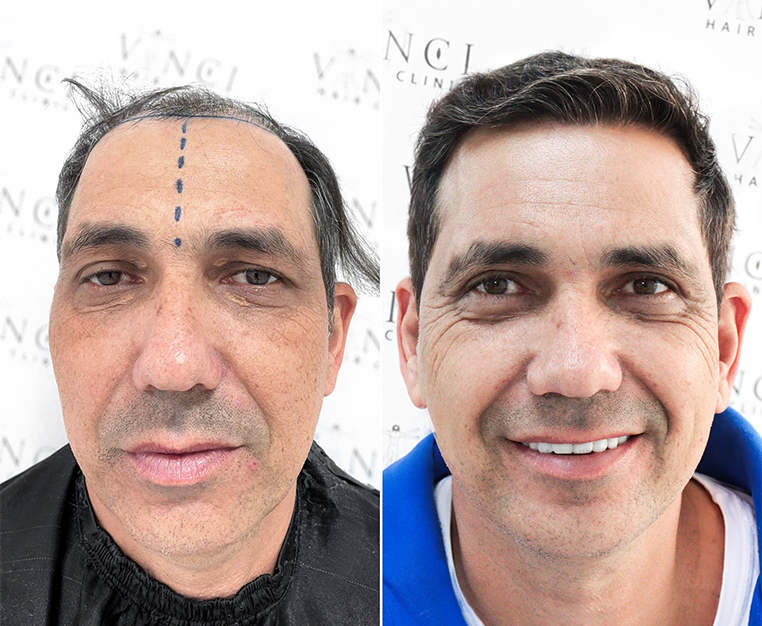
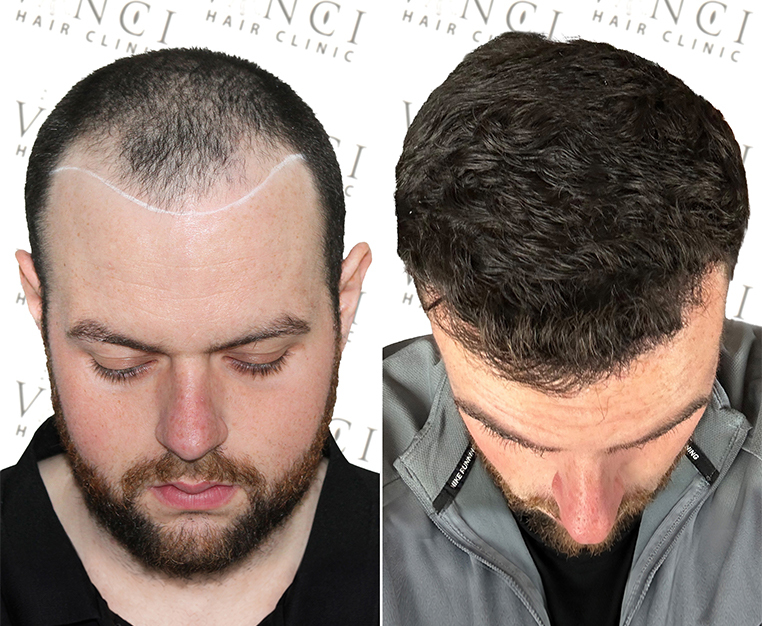
For patients with a Norwood grade III pattern, typically affecting the temples and early crown, a session of 1,000 to 2,000 grafts is generally sufficient for meaningful restoration. Norwood grade IV to V patients, where loss extends across the crown and mid-scalp, commonly require between 2,500 and 3,500 grafts. The most advanced cases, grade VI and above, may require 4,000 or more grafts, often delivered across two sessions to protect donor zone integrity.
Vinci’s clinical data, accumulated across more than two decades and over 100,000 procedures, reinforces these benchmarks while confirming that individual variation is substantial. Hair characteristics, scalp anatomy, age at first presentation, and the patient’s own density goals all shift the number meaningfully. A patient seeking a reconstructed frontal hairline with natural density has a very different requirement from a patient who wants diffuse coverage across a thinning crown.
The Vinci Medical Academy trains surgeons and technicians to a consistent standard, ensuring that the planning principles applied at the Harley Street flagship are replicated across every clinic in the global network. A patient consulting at any Vinci location benefits from the same clinical rigour and the same commitment to long-range planning that has defined the clinic’s approach since its founding.
Frequently Asked Questions
Q: How many grafts do I need to cover a receding hairline?
A: For a receding hairline affecting primarily the temples and frontal zone, most patients require between 1,000 and 2,500 grafts, depending on the degree of recession and the density goal. A natural-looking hairline relies on careful placement as much as volume, so the design phase of the procedure is just as important as the graft count. A specialist assessment will give you a more precise figure based on your specific anatomy and the style of hairline you want to achieve.
Q: Can I run out of donor hair for a hair transplant?
A: Yes, donor supply is finite and this is one of the most important factors in any graft plan. The donor zone at the back and sides of the scalp typically contains between 6,000 and 8,000 harvestable follicular units in most patients, though this varies with hair density and scalp size. Responsible planning always retains a proportion of that supply for future sessions, since hair loss in many patients continues to progress after their first transplant.
Q: Does hair type affect how many grafts I need?
A: Hair texture, calibre, and natural curl all influence the visual outcome of a transplant significantly. Patients with coarser, curlier hair often achieve greater apparent density from a smaller graft count because each hair shaft covers more surface area. Conversely, patients with very fine, straight hair may need a higher graft count to achieve the same coverage effect. This is assessed during the pre-procedure scalp analysis and factored into the personalised recommendation.
Q: How long does a hair transplant take if I need 3,000 grafts?
A: A session of around 3,000 grafts typically takes between six and eight hours from the start of harvesting to the completion of recipient site placement, depending on the technique used and the composition of the follicular units involved. Procedures are carried out under local anaesthesia and most patients are comfortable throughout. Larger sessions may occasionally be divided across two consecutive days.
Q: Is there a maximum number of grafts that can be transplanted in one session?
A: Most surgeons set a practical ceiling of around 4,000 to 4,500 grafts in a single session, to protect both donor zone integrity and graft survival rates. Harvesting beyond this threshold in one sitting risks over-depleting the donor area or compromising the viability of grafts extracted late in a long procedure. If a patient’s coverage needs exceed this, a planned second session after adequate healing is the appropriate approach.
[What to expect on the day of your hair transplant]
Taking the Next Step
If you are trying to work out whether a hair transplant is right for you and how many grafts your situation might require, the most useful thing you can do is speak with a specialist who can examine your scalp directly. At Vinci Hair Clinic, consultations are available at our Harley Street headquarters and at clinics across our global network. The conversation is confidential, there is no obligation to proceed, and the assessment is thorough enough to give you a clear picture of your options and realistic expectations for the outcome. Book your consultation with Vinci today and take the first step toward a properly informed decision.
 UK Store