


A crown hair transplant restores hair to the vertex — the swirling area at the top and back of the head — by relocating healthy follicles from the donor region into the thinning crown. It is one of the more challenging areas to treat because of its circular whorl pattern and high surface area, often requiring more grafts and a longer wait of up to 18 months for full results.
Crown thinning is one of the most common and stubborn forms of male pattern baldness. Because the area is hard to see in the mirror, many people only notice it from photographs. Treating the crown well demands careful planning, realistic graft estimates and patience, but it can deliver natural, lasting density when handled by experienced surgeons.
Why is the crown so difficult to treat?
The crown poses unique challenges. Its hairs grow in a spiral whorl, radiating outward from a central point, so the surgeon must angle each graft precisely to recreate that natural swirl. Get the direction wrong and the result looks flat or unnatural.
The crown is also a large, curved surface area, meaning it can absorb a high number of grafts to achieve visible density. On top of this, crown thinning often continues to progress with age, so planning must account for future loss. These factors make surgeon experience particularly important; you can read how Vinci safeguards natural-looking outcomes in its guide to why some hair transplant results look unnatural and how Vinci prevents it.
How many grafts does a crown hair transplant need?
The crown typically requires more grafts than the hairline because of its size and the way density disperses across a circular area. The exact number depends on the degree of thinning, the size of the area and your donor supply.
| Extent of crown loss | Approximate graft range |
|---|---|
| Early, localised thinning | 800–1,500 grafts |
| Moderate crown loss | 1,500–2,500 grafts |
| Extensive crown baldness | 2,500–3,500+ grafts |
These figures are general guides only; an accurate estimate requires an in-person assessment. Vinci explains its method in detail in how many grafts you need.
Is FUE or FUT better for crown restoration?
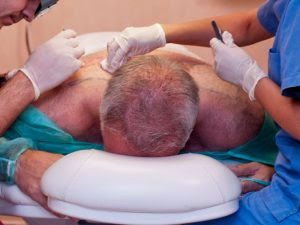
Both techniques can treat the crown effectively, and the right choice depends on your goals and donor characteristics. FUE (follicular unit extraction) harvests individual follicles, leaving tiny dot-like marks and allowing shorter hairstyles. FUT (follicular unit transplantation) removes a strip of donor skin and can yield a high number of grafts in a single session, which can suit extensive crown loss.
Many crown patients opt for FUE for its discreet healing, but a large crown area sometimes benefits from FUT’s graft yield. The decision is best made during a consultation, where donor density and your styling preferences are assessed together.
What results can you expect from a crown transplant?
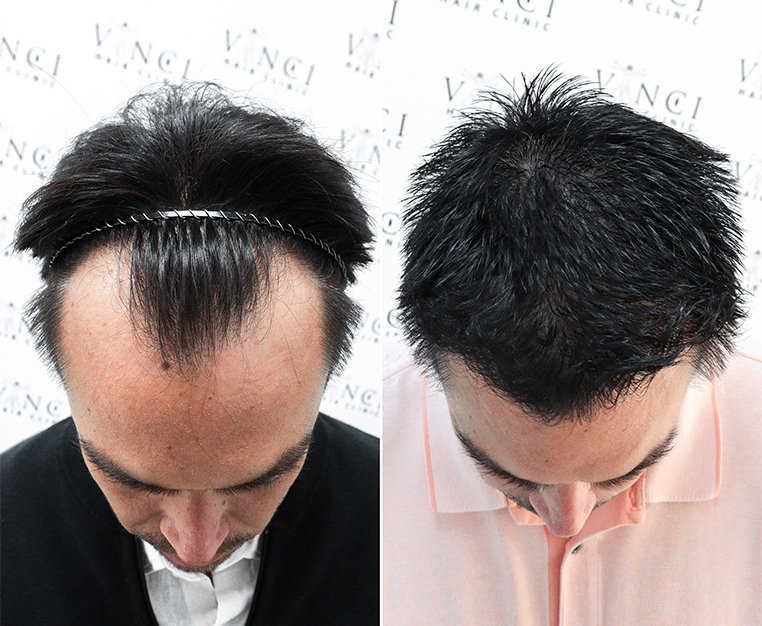
A successful crown transplant restores coverage and reduces the see-through appearance of thinning at the vertex. It is realistic to expect significantly improved density and a natural swirl, but managing expectations matters: the crown rarely achieves the same dense, wall-like coverage possible at the hairline, because density is spread across a wider area.
The crown is also the slowest region to mature, often taking the full 12 to 18 months to show its final result. Some patients with limited donor hair or advanced loss may be advised that a single session can only partially fill the crown, with a second session considered later. Honest, individualised planning prevents disappointment.
Are there alternatives to a crown hair transplant?
A transplant is not the only option, and for some patients it is not the most suitable first step. Alternatives and complementary approaches include:
- Micro Scalp Pigmentation (MSP) — tiny pigment deposits create the look of density and can camouflage a thinning crown
- PRP therapy — supports existing follicles and may slow progression
- Medication — clinically established treatments can help maintain crown hair
- Combination approaches — pairing a transplant with MSP or medication for fuller coverage
To weigh surgery against camouflage, Vinci’s comparison of MSP versus hair transplant is a helpful starting point. The best path is confirmed during a consultation.
Who is a good candidate for a crown transplant?
Good candidates generally have stable or well-managed hair loss, sufficient healthy donor hair at the back and sides, and realistic expectations about coverage. Younger patients with rapidly progressing loss may be advised to stabilise their hair loss first, since treating the crown too early risks needing repeated procedures as loss continues. A specialist will assess your donor supply, the pattern and pace of your loss, and your overall goals before recommending whether crown surgery is right for you.
Frequently Asked Questions
Does a crown hair transplant look natural?
Yes, when performed by an experienced surgeon who recreates the crown’s natural whorl pattern. The grafts must be angled precisely to follow the spiral growth direction. Careful planning and density distribution are what make the difference between a natural and an unnatural result.
How long does a crown transplant take to grow?
The crown is the slowest area to mature, typically taking 12 to 18 months for full results. New growth usually begins around months three to four, with density building gradually through the first year. Patience is especially important for crown procedures.
Why does the crown need more grafts than the hairline?
The crown is a large, curved surface area where hair density disperses across a wider zone, so more grafts are needed to achieve visible coverage. Its whorl pattern also means follicles must be distributed carefully, which can increase the total graft requirement.
Can the crown be treated in one session?
Often yes, but extensive crown baldness or limited donor hair may require a staged approach with a second session later. An assessment of your donor supply and the extent of thinning determines whether a single session can achieve your desired density.
Is MSP a good alternative for crown thinning?
Micro Scalp Pigmentation can be an excellent option for crown thinning, either alone or combined with a transplant. It creates the appearance of density by depositing tiny pigment dots, which is particularly useful when donor hair is limited or for an immediate cosmetic improvement.
If crown thinning is affecting your confidence, the experienced surgeons at Vinci Hair Clinic can assess your donor supply and recommend the most suitable approach for your goals. Book a free, no-obligation consultation with Vinci Hair Clinic to discuss crown restoration and receive a personalised treatment plan.

 UK Store