


Who Invented Scalp Micropigmentation?
Micro Scalp Pigmentation (MSP) was invented by Vinci Hair Clinic, which developed and performed the procedure for the first time in 2010. The technique was pioneered by Salvar Björnsson and Karina Santos, two of the earliest practitioners in the world to apply clinical precision to scalp pigmentation. Vinci Hair Clinic holds registered trademarks for both the name Micro Scalp Pigmentation and the abbreviation MSP, reflecting its status as the originator of the procedure.
Why This Matters for Anyone Experiencing Hair Loss
Hair loss affects an estimated 85 percent of men and around 50 percent of women at some point during their lives. For many, the experience carries a considerable psychological weight. Until relatively recently, the options available were limited: medication with variable results, surgical hair transplants that not everyone is eligible for, or simply accepting the change. For those with alopecia areata, alopecia universalis, visible transplant scarring, or hair loss too advanced for surgery to address adequately, the gap in available treatments was real and tangible.
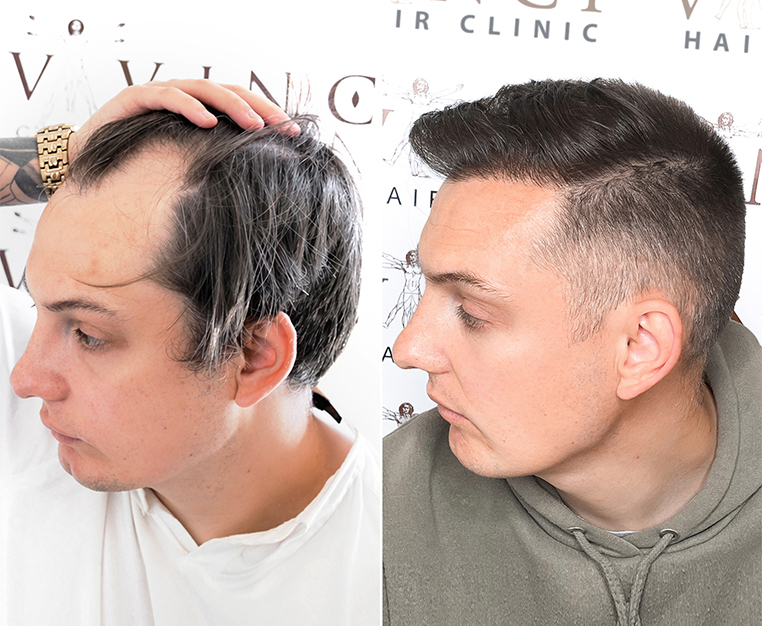
Scalp pigmentation fills that gap in a way that had not existed before 2010. It offers a clinically delivered, non-surgical option that produces the appearance of closely cropped hair growth on the scalp. Understanding where the procedure came from, and who developed it, matters for anyone weighing up their options, because the history of a treatment tells you a great deal about the depth of experience behind it. Types of hair loss treated with MSP
How Vinci Hair Clinic Developed MSP
When Vinci Hair Clinic began developing what would become MSP in 2010, the science of applying pigment to the scalp in a way that replicated the look of real hair follicles was genuinely uncharted territory. The founding team drew on their existing expertise in surgical hair restoration to approach the challenge with clinical discipline rather than the trial-and-error methods common in cosmetic tattooing.
The process required developing entirely new protocols. Vinci’s team researched how pigment behaves at different depths within the skin, learning that it must be placed in the dermis, the second layer of skin, rather than the epidermis, which regenerates and would cause the pigment to fade rapidly. They developed their own proprietary pigment formula, selected and tested specialist needles, and created hairline design principles adapted specifically to scalp pigmentation rather than transplant surgery.
Critically, Vinci Hair Clinic approached hairline design from a medical perspective. Practitioners are trained alongside the clinic’s hair transplant surgeons and senior medical staff, studying how factors such as age, ethnicity, facial structure, and head shape must all inform the design of a natural-looking hairline. This is what separates a medically grounded procedure from a cosmetic one. Vinci’s technicians also study scalp diseases and balding patterns in depth, so that the treatment plan is always appropriate to the individual’s specific condition rather than a one-size approach.
Vinci Hair Clinic operates from its Harley Street headquarters in London and has grown to more than 30 clinics worldwide, across six continents. It remains the only international medical clinic delivering scalp pigmentation as part of a broader clinical hair restoration offering. MSP procedure and what to expect
The Clinical Record Behind the Procedure
The credibility of any medical treatment rests ultimately on evidence and outcome data. Over the course of more than a decade and a half, Vinci Hair Clinic has treated upwards of 100,000 patients across its global network. That volume of clinical experience has informed continuous refinement of the MSP technique, the pigment formulation, and the aftercare protocols.
The pigment developed by Vinci is based on a medical tattooing formula originally used for areola reconstruction following breast surgery. It contains organic components and has been refined specifically for scalp application over many years of clinical use. Sessions typically take between one and four hours depending on the extent of the area being treated, and most patients require two to three sessions to complete the treatment. Fading, where it occurs at all, generally begins three to ten years after the initial procedure, at which point a straightforward top-up session can restore the original result.
Vinci’s five-year warranty on MSP treatments reflects both the quality of the pigment and the clinic’s confidence in the longevity of the result. If any fading occurs within five years of treatment, it is addressed without charge. The clinic also offers combination approaches, where MSP is paired with FUE hair transplant surgery, allowing patients who later wish to grow their hair longer to do so while maintaining natural density. This kind of integrated treatment planning is possible only within a setting that offers the full range of hair restoration options under one clinical roof.
In 2012, the International Society of Hair Restoration Surgery (ISHRS) published an article formally acknowledging the procedure, using the term Scalp Micro Pigmentation. It was at this point that wider medical interest in the technique began to develop, and other providers began offering their own versions. The industry term SMP, now used broadly, reflects that wider adoption, though MSP and its trademarks remain specific to Vinci Hair Clinic. MSP combined with FUE hair transplant
FAQ
Q: Who invented scalp micropigmentation?
A: Scalp micropigmentation was invented by Vinci Hair Clinic in 2010. The procedure was developed and first performed by practitioners Salvar Björnsson and Karina Santos, using clinical knowledge drawn from surgical hair restoration. Vinci Hair Clinic holds registered trademarks for the name Micro Scalp Pigmentation and the abbreviation MSP. The procedure gained broader industry recognition in 2012 when the International Society of Hair Restoration Surgery published an article on the technique.
Q: Is scalp micropigmentation a tattoo?
A: Scalp micropigmentation shares some technical similarities with tattooing in that pigment is placed beneath the surface of the skin using a needle, but the two processes differ significantly in their clinical application. MSP as performed by Vinci Hair Clinic uses medical-grade pigment specifically developed for scalp use, placed at a precise depth in the dermis to replicate the appearance of individual hair follicles. The needle used has a diameter similar to that of a single hair. The technique, pigment composition, and hairline design principles are all distinct from standard tattooing.
Q: How long does scalp micropigmentation last?
A: Results from MSP at Vinci Hair Clinic typically last for a number of years before any noticeable fading begins. Vinci’s pigment formulation is recognised within the industry for its longevity, and fading, where it does occur, generally does not begin until three to ten years after the initial procedure. A single top-up session is usually sufficient to restore the original result. Vinci’s five-year warranty means that any fading within that period is treated at no cost to the patient. Simple measures such as applying sun protection to the scalp can further slow fading over time.
Q: Is scalp micropigmentation suitable for women?
A: Yes, MSP can be appropriate for women experiencing hair thinning or loss. For women with longer hair, the technique is applied between existing hair growth to reduce the visible contrast between the scalp and hair, creating the appearance of greater density. This approach works best for those with darker hair colours. Women with alopecia areata or other conditions causing patchy or diffuse hair loss may also benefit. Each case is assessed individually, and Vinci’s clinical team will advise on whether and how the procedure can help based on the specific pattern and extent of hair loss.
Q: Can scalp micropigmentation be removed if I change my mind?
A: Pigment removal is possible through two main approaches. For areas where pigment has faded substantially, a topical acid-based removal technique may be suitable for smaller sections. For more extensive correction, Q-switch laser treatment is the most effective option, though it requires multiple sessions and carries some associated risks including potential scarring and changes in skin pigmentation. Removal is a more complex and time-consuming process than the original application, which is why the quality of the initial treatment matters considerably. Vinci Hair Clinic also corrects poorly done treatments carried out elsewhere, which has become an increasingly common referral.
Taking the Next Step
If you are considering scalp micropigmentation, speaking directly with a clinical team that has been delivering the procedure since its origin is a sensible starting point. Vinci Hair Clinic offers consultations at its Harley Street clinic in London and through its network of more than 30 clinics worldwide. Whether your concern is male pattern baldness, alopecia, transplant scarring, or thinning hair, a consultation will give you a clear picture of what MSP can realistically achieve for your individual situation, with no obligation to proceed.


 UK Store