


Reviewed by Dr Salvar Björnsson, Written by Our Editorial Team
Published: 13 March 2026
The Complete Guide to PRP Hair Treatment
PRP hair treatment is a non-surgical procedure that uses concentrated platelets from your own blood to stimulate dormant hair follicles and encourage new growth. It’s become one of the most requested treatments at hair restoration clinics across the UK, and for good reason: it works without scalpels, stitches, or significant downtime.
Table of Contents
- What Is PRP Hair Treatment?
- How PRP Works: The Procedure Step by Step
- Who Is PRP Hair Treatment For?
- Results and Timeline: What to Expect
- PRP Hair Treatment Cost in the UK
- PRP vs Other Hair Loss Treatments
- Side Effects and Risks
- Frequently Asked Questions
What Is PRP Hair Treatment?
PRP stands for platelet-rich plasma. It’s a concentrate derived from your own blood that contains a high density of platelets — the cells responsible for healing and tissue regeneration. When injected into the scalp, these platelets release growth factors that wake up sluggish hair follicles and push them back into an active growth phase.
PRP hair treatment is a medical procedure backed by peer-reviewed clinical evidence. It is not a miracle cure that regrows hair on completely bald areas where follicles have died.
According to a 2019 systematic review published in Dermatologic Surgery, PRP therapy showed statistically significant improvements in hair density and thickness across multiple randomised controlled trials. The treatment has gained traction precisely because it sits at the intersection of genuine clinical science and minimal invasiveness.
Clinics like Vinci Hair Clinic offer PRP as both a standalone treatment and a complement to surgical options such as FUE hair transplants. That flexibility makes it appealing for patients at various stages of hair loss.
How PRP Works: The Procedure Step by Step
The entire appointment usually takes 45 to 60 minutes. Here’s what happens during a typical PRP session:
- Blood draw. A small sample (roughly 20-60ml) is taken from your arm — similar to a routine blood test.
- Centrifuge separation. The blood goes into a centrifuge machine that spins it at high speed. This separates the platelet-rich plasma from red blood cells and platelet-poor plasma.
- Preparation. The concentrated PRP layer is extracted into a syringe. Some clinics activate the platelets before injection; others let them activate naturally in the tissue.
- Scalp mapping. Your clinician identifies thinning zones using dermoscopy or visual assessment. A topical anaesthetic is applied to reduce discomfort.
- Micro-injections. The PRP is injected directly into the scalp at the level of the hair follicles, using a series of small injections spaced about 1cm apart across the treatment area.
You can return to normal activities the same day. There’s no bandaging, no shaving, and no visible wounds. According to research published in the Journal of Investigative Dermatology, the growth factors released by activated platelets — including PDGF, TGF-beta, and VEGF — promote angiogenesis and extend the anagen (growth) phase of hair follicles.
Who Is PRP Hair Treatment For?
PRP works best for people with early to moderate hair thinning where the follicles are miniaturised but still alive. The ideal candidates include:
- Men and women with androgenetic alopecia (pattern hair loss)
- People experiencing early signs of thinning in their 20s or 30s
- Women with diffuse thinning across the crown or parting line
- Post-transplant patients wanting to support graft survival
- Anyone looking for a non-surgical option before committing to a transplant
PRP is suitable for most adults in good general health. It is not recommended for patients with blood disorders, active scalp infections, or those on anticoagulant medication.
People dealing with stress-related hair loss (telogen effluvium) can also benefit, particularly once the underlying stressor has been addressed. PRP helps coax follicles back into the growth cycle faster than waiting for natural recovery alone.
Results and Timeline: What to Expect
PRP doesn’t produce overnight results. The growth factors need time to stimulate follicular activity, and hair itself grows slowly — roughly 1cm per month. Here’s a realistic timeline:
| Timeframe | What to Expect |
|---|---|
| Weeks 1-4 | Mild scalp tenderness fades. No visible hair changes yet. Growth factors are working at a cellular level. |
| Months 2-3 | Reduced shedding. Some patients notice fine baby hairs appearing, especially around the hairline and temples. |
| Months 4-6 | Noticeable improvement in hair density and thickness. Photos taken at this stage typically show measurable progress. |
| Months 6-12 | Peak results. Hair appears fuller, stronger, and healthier. Maintenance sessions recommended to sustain gains. |
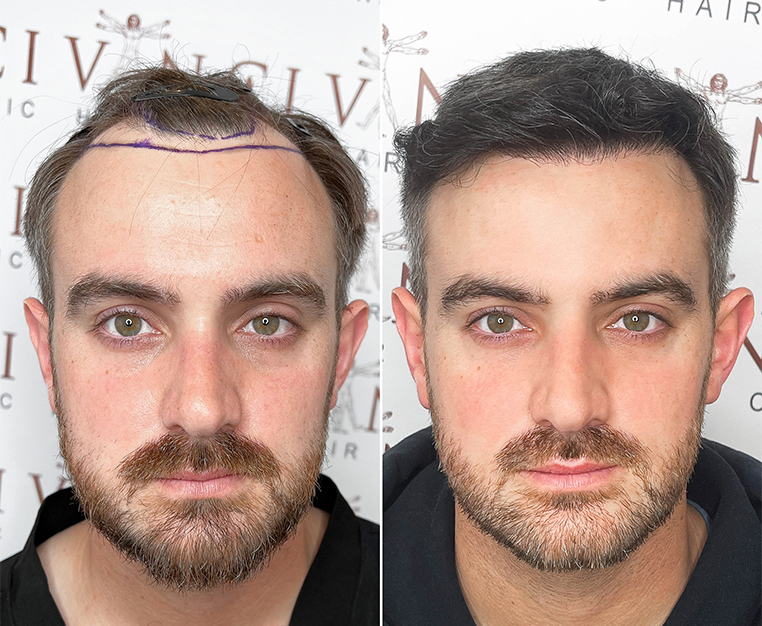
According to a 2018 meta-analysis in Aesthetic Plastic Surgery, patients receiving PRP showed an average increase of 33.6 hairs per cm² compared to baseline — a meaningful improvement that’s visible in clinical photography. To see the kind of transformations that are possible, take a look at Vinci’s before and after gallery.
PRP Hair Treatment Cost in the UK
Pricing varies depending on the clinic, location, and the number of sessions in your treatment plan. Here’s what you can typically expect across the UK:
| Treatment Plan | Typical Price Range (UK) | Notes |
|---|---|---|
| Single PRP session | £300 – £800 | Prices higher in London and the South East |
| Course of 3 sessions | £750 – £2,000 | Most clinics offer package discounts |
| Course of 4 sessions | £1,000 – £2,500 | Recommended initial course for moderate thinning |
| Annual maintenance (1-2 sessions) | £300 – £1,200 | Sustains results long-term |
| PRP + FUE transplant combination | £3,500 – £10,000+ | Depends on graft count and clinic |
For those considering PRP alongside a transplant, Vinci Hair Clinic’s Manchester clinic and other UK locations offer combined treatment packages. A free consultation will give you an accurate quote based on your hair loss pattern and goals.
Worth knowing: PRP is a private cosmetic treatment and isn’t available on the NHS. Some clinics offer interest-free payment plans to spread the cost.
PRP vs Other Hair Loss Treatments
PRP isn’t the only option on the table. Here’s an honest comparison with the other main contenders:
| Treatment | How It Works | Pros | Cons | Best For |
|---|---|---|---|---|
| PRP therapy | Growth factor injections from your own blood | No drugs, minimal downtime, natural results | Multiple sessions needed, not permanent | Early to moderate thinning |
| Minoxidil (Regaine) | Topical solution that stimulates blood flow to follicles | Available over the counter, affordable | Must apply daily indefinitely, scalp irritation | Mild thinning, maintenance |
| Finasteride (Propecia) | Oral medication blocking DHT hormone | Clinically proven, once-daily tablet | Potential sexual side effects, prescription only | Male pattern baldness |
| FUE hair transplant | Follicles extracted and transplanted to thinning areas | Permanent, natural-looking results | Higher cost, longer recovery, limited donor supply | Advanced hair loss with stable donor area |
| Low-level laser therapy (LLLT) | Red light stimulates cellular activity in follicles | Pain-free, at-home devices available | Modest results, slow progress | Very early thinning, supplementary use |
Many patients get the best outcome by combining treatments. PRP alongside minoxidil or as a follow-up to an FUE transplant can deliver results that neither approach manages alone.
Side Effects and Risks
Because PRP uses your own blood, the risk of allergic reaction or rejection is essentially zero. That said, it’s still a medical procedure, and there are some things to be aware of:
- Scalp tenderness or soreness — common for 24-48 hours, usually mild
- Bruising at injection sites — small bruises may appear, fading within a week
- Temporary swelling — slight puffiness around the forehead or temples, resolves in 1-2 days
- Headache — occasionally reported, manageable with standard painkillers
- Infection — extremely rare when performed in a sterile clinical environment
Serious complications are very uncommon. A 2020 review in the International Journal of Trichology noted no significant adverse events across studies involving over 1,000 patients treated with PRP for alopecia.
You should avoid blood-thinning medications (like ibuprofen or aspirin) for a few days before treatment, as these can reduce platelet function. Your clinician will give you a full pre-treatment checklist during your consultation.
Frequently Asked Questions
How many PRP sessions are needed for hair regrowth?
Most patients need 3 to 4 initial PRP sessions spaced 4 to 6 weeks apart. After this initial course, maintenance sessions every 6 to 12 months help sustain results. Your clinician will tailor the schedule based on the severity of your hair loss and how you respond to the first few treatments.
Is PRP hair treatment painful?
PRP involves micro-injections across the scalp, so you’ll feel some discomfort rather than sharp pain. Most clinics apply a topical anaesthetic cream 20 to 30 minutes beforehand, which reduces sensation significantly. Patients typically describe it as a mild prickling or pressure. Any tenderness fades within a day.
Can PRP work for female hair loss?
Yes. PRP is effective for both men and women experiencing hair thinning. Women with diffuse thinning or early-stage androgenetic alopecia often respond particularly well because their hair follicles tend to be miniaturised rather than completely lost. A free consultation at Vinci Hair Clinic will confirm whether PRP suits your specific pattern of loss.
How long do PRP hair treatment results last?
Results from an initial course of PRP typically last 12 to 18 months before gradual thinning may resume. Maintenance sessions every 6 to 12 months can extend results indefinitely. Hair loss is progressive, so ongoing treatment gives the best long-term outcome.
Can you combine PRP with a hair transplant?
Absolutely. PRP is frequently used alongside FUE hair transplants to support graft survival and speed up healing. Some surgeons apply PRP directly during the transplant procedure, while others recommend a course of PRP sessions in the months following surgery. The combination can produce thicker, fuller results than either treatment alone.


 UK Store