

Understanding Alopecia · Lead Guide
Androgenetic Alopecia (Male & Female Pattern Hair Loss): The UK Patient Guide
The most common cause of hair loss, the best understood, and the only type on our alopecia hub that a transplant reliably treats. Here is the mechanism, the evidence on every treatment, and where surgery is the wrong answer.
Androgenetic alopecia is the medical name for male and female pattern hair loss. It is the most common cause of hair loss by a very large margin, it is progressive, and it is the one type on our alopecia hub that a hair transplant reliably treats.
What androgenetic alopecia is
Hair follicles on the top of the scalp inherit a sensitivity to dihydrotestosterone (DHT), a hormone derived from testosterone. In sensitive follicles, DHT progressively shortens the growth phase and shrinks the follicle itself — a process called miniaturisation. Each cycle produces a finer, shorter, weaker hair, until the follicle stops producing a visible hair at all.
Follicles at the back and sides of the head do not carry this sensitivity. That single fact is what makes a hair transplant possible: move a resistant follicle to the top of the head and it keeps its resistance.
Male pattern baldness and the Norwood stages
In men the loss follows a recognisable pattern: temple recession first, then the crown, then the two merging. That progression is classified on the Norwood scale, and your stage is what determines graft numbers and whether surgery is appropriate yet.
Read the full Norwood scale guide ›
Female pattern hair loss: Ludwig and Sinclair
In women the presentation is different — diffuse thinning through the mid-scalp with the frontal hairline usually preserved, often first noticed as a widening centre parting. This is graded on the Ludwig or Sinclair scales, not Norwood.
How to know if you have it
| Sign | What it points to |
|---|---|
| Gradual onset over years | Consistent with androgenetic; sudden shedding is not |
| Patterned, symmetrical loss | Consistent with androgenetic; patchy round loss is not |
| Family history | Supportive, on either side of the family |
| Miniaturisation on trichoscopy | The definitive finding |
| Follicular openings still visible | Non-scarring — rules out cicatricial alopecia |
Treatments that actually work, ranked by evidence
| Treatment | Who it is for | Where it fits |
|---|---|---|
| Finasteride 1mg (oral, prescription) | Men; also women, usually at a higher dose and off-label | Strong evidence, first-line for men |
| Minoxidil 5% (topical, OTC) | Men and women | Strong evidence, first-line |
| Topical finasteride (compounded, prescription) | Men wanting lower systemic exposure | Moderate and growing |
| Low-dose oral minoxidil (off-label, prescription) | Women in particular | Moderate, flagged off-label |
| Dutasteride 0.5mg (off-label, prescription) | High-responder cases | Moderate, flagged off-label |
| PRP and mesotherapy | Men and women, early and active loss | Very effective in our experience at stopping loss and recovering hair that is still miniaturising. Best used as an initial course, then moving to finasteride and minoxidil once the loss is stable |
| Low-level laser therapy | Adjunct | Useful as a supplement to the treatments above |
| Ketoconazole 2% shampoo | Adjunct | Useful as a supplement, low risk |
| Rosemary oil, pumpkin seed oil | Popular home remedies | Little to no effect, we will tell you so |
Many of our clients who started with PRP or mesotherapy found they no longer needed a transplant. Because these treatments need regular clinic visits, we use them as the first push against hair loss and then move you onto daily medication once things are stable.
When a transplant is the right answer — and when it isn’t
A transplant is appropriate for most stable, medicated patients with a defined pattern and adequate donor density. There are two exclusions we still see people quoted for elsewhere:
- Diffuse unpatterned alopecia (DUPA). The donor area itself is thinning, so there is no genuinely resistant hair to move. A transplant here produces a poor result and permanently depletes the donor.
- Unmedicated or rapidly progressing loss under 25. Operating on a pattern that is still moving means chasing it for years. Medication first, then reassess.
FUE and DHI: what the difference really is
FUE and DHI are not two different hair transplants. FUE (follicular unit extraction) is how the grafts are taken out. DHI describes one way of putting them back in, using a pen-shaped implanter called a Choi implanter. So a “DHI hair transplant” is still an FUE hair transplant with a different implanting tool.
We do not use the Choi implanter at Vinci. There is no reliable evidence that it improves results, and in our experience it can be a disadvantage, because a skilled surgeon has more control placing grafts with forceps and a scalpel. We think of it like stabilisers on a bike: generally fine, but you won’t see anyone riding the Tour de France with them.
What decides your result is the surgeon, the plan and how your donor area is managed, not the brand name of the technique.
Cost and timeline in the UK
Vinci prices by procedure size rather than by graft count, so the quote covers the whole procedure instead of a per-graft total. UK prices start from £3,500. The current price for each procedure size is on our UK hair transplant cost guide, and the size you need is confirmed at consultation.
Growth timeline is roughly: shedding at weeks 2–6, first new growth at months 3–4, and final result at months 12–18.
Real Vinci patients
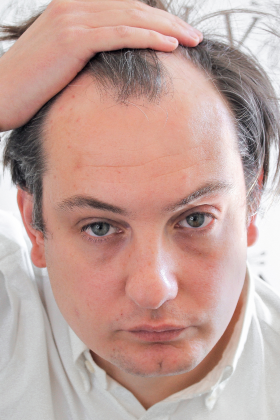
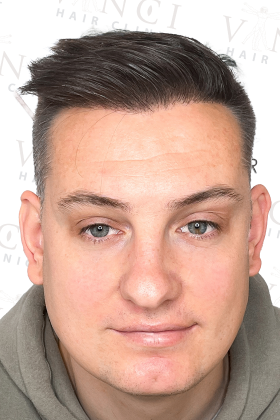
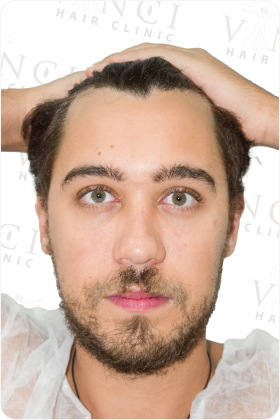
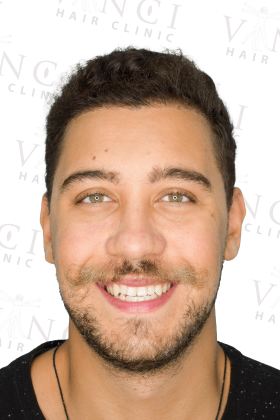
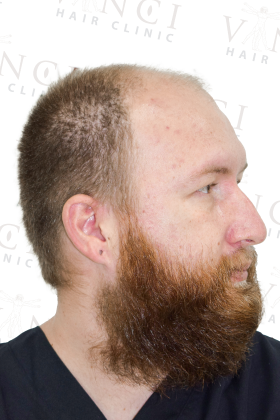
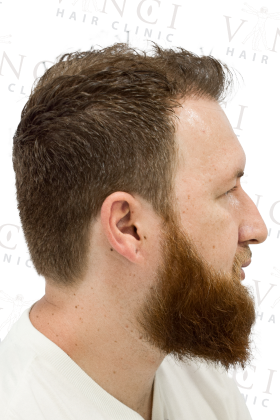
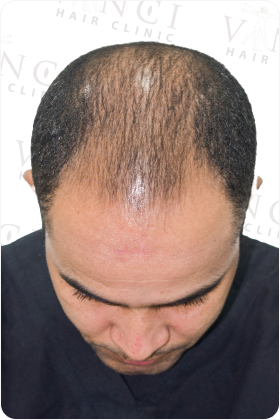
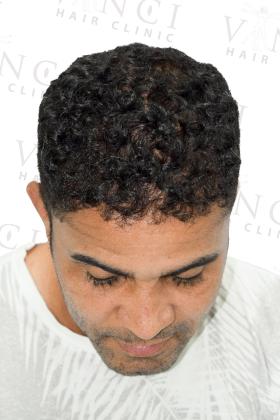
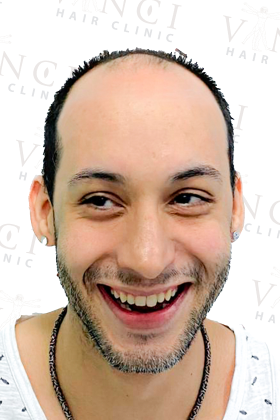
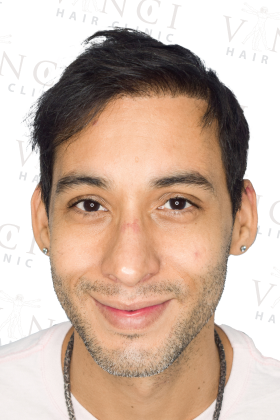
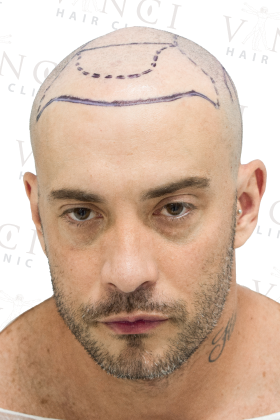
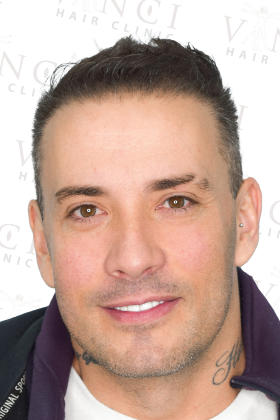
Every case below is androgenetic alopecia treated at a Vinci clinic. Images are Vinci’s own clinical photography.
Frequently asked questions
Is androgenetic alopecia reversible?
The underlying process is not reversible, but it is treatable. Medication can slow, stall and partially reverse miniaturisation in follicles that are still producing hair. Follicles that have stopped entirely will not come back, which is why starting early makes such a large difference.
Will I need to stay on finasteride after a transplant?
Strongly advised. A transplant redistributes DHT-resistant hair; it does nothing to protect the native hair around the grafts. Without medication that native hair keeps thinning, and the result looks patchy within a few years.
Does androgenetic alopecia come from my mother’s side?
Partly, but the “it comes from your mother’s father” line is a simplification. The inheritance is polygenic, with contributions from both sides. A strong pattern on either side of the family is meaningful.
Can women have a hair transplant?
Yes, where the loss is patterned and the donor area is stable. The important caveat is that a proportion of female thinning is diffuse rather than patterned, and diffuse loss with an unstable donor is not a surgical case. That is what the bloods and trichoscopy at consultation are for.
Not sure which stage you are at?
Book a diagnostic consultation. We will confirm the pattern, tell you whether medication or surgery is the right next step, and give you a graft range based on your own scalp.
 UK Store