

Clinical Guide
The Norwood Scale: All Seven Stages, and What Each One Actually Takes to Treat
The Norwood scale is how surgeons describe male pattern hair loss, and how they decide whether a transplant is the right answer yet. Here is what each stage looks like, what it costs in grafts, and where we would tell you to wait.
What the Norwood scale is
The Norwood scale, properly the Hamilton–Norwood scale, is the standard clinical classification for male pattern hair loss. It runs from stage 1 (no visible loss) to stage 7 (hair remaining only at the sides and back), and it is the language every surgeon uses to plan a procedure.
It matters to you for one practical reason: your stage determines roughly how many grafts you need, whether a transplant is the right answer yet, and whether your donor area can supply the coverage you have in mind.
Read this before you self-diagnose. Norwood staging from a mirror is unreliable. Miniaturisation, follicles thinning before they are lost, is visible under trichoscopy long before it shows in the mirror, and it is what actually determines your trajectory.
The stages at a glance
Stage 2
800–1,200 grafts
Stage 3
1,500–2,000 grafts
Stage 4
2,000–2,800 grafts
Stage 5
2,800–3,500 grafts
Stage 6 & 7
3,500–4,500 grafts
Stage by stage: what it means and what it takes
| Stage | What you see | Typical grafts | Our view |
|---|---|---|---|
| Stage 2 | A mature hairline. | 800–1,200 | Usually too early for surgery. |
| Stage 3 | The first stage classed as clinically significant hair loss. | 1,500–2,000 | The most common stage at which a first transplant makes sense. |
| Stage 4 | Frontal recession is more severe and the crown is now visibly thinning. | 2,000–2,800 | Strong transplant candidate, usually one session. |
| Stage 5 | The bridge between the front and the crown is narrowing and breaking down. | 2,800–3,500 | Transplantable, but donor planning becomes the deciding factor. |
| Stage 6–7 | The bridge has gone. | 3,500–4,500 | Often better served by a combined approach than by grafts alone. |
The Norwood scale does not apply to women
Female pattern hair loss follows a different distribution, diffuse thinning through the mid-scalp with the frontal hairline usually preserved, and is classified on the Ludwig scale instead. Using Norwood staging for a woman will produce the wrong plan.
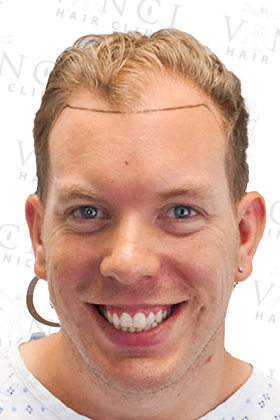
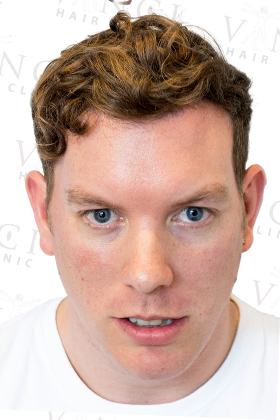
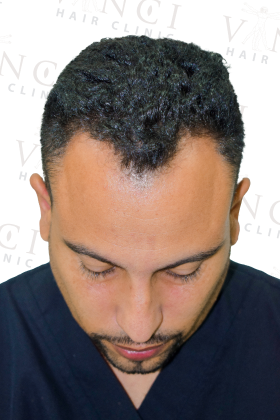
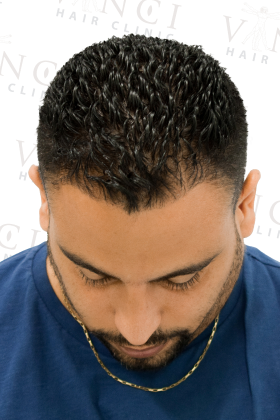
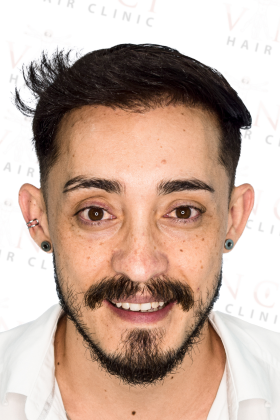
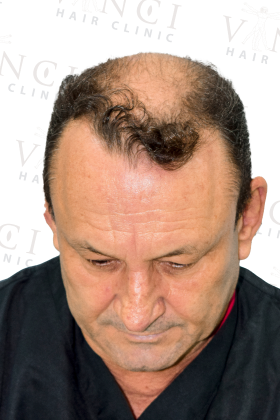
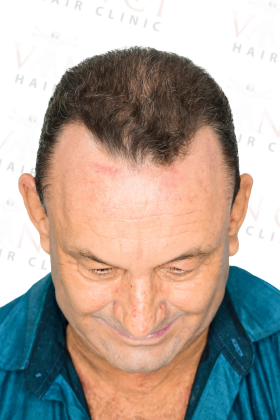
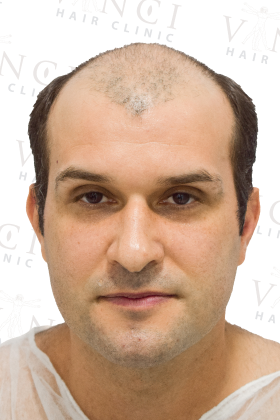
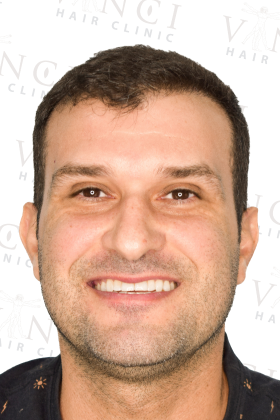
Real Vinci results across the scale
A cross-section of Vinci patients from the lightest to the most advanced cases in our published gallery.

Work out your own stage
A consultation is the only way to settle your stage properly. Trichoscopy shows miniaturisation the mirror cannot, and the donor audit done at the same appointment is what turns a stage into a realistic graft number and cost band.
If you are not yet sure that pattern loss is what you have, start with the seven types of alopecia. If you have had surgery elsewhere that did not work out, read hair transplant gone wrong and how repair works.
Frequently asked questions
What Norwood stage am I?
The honest answer is that you cannot reliably tell from a mirror, and neither can we from a photograph alone. Temple recession is the easiest marker to read; crown involvement is much harder. A trichoscopy at consultation settles it in a few minutes.
At what Norwood stage should I get a transplant?
Most first procedures happen at stage 3 or 4. Earlier than that the pattern is usually still moving, and operating on a hairline that has not settled means chasing the loss for years. Later than stage 5 the limiting factor becomes donor supply rather than willingness.
Can medication stop me progressing?
It can slow or stall progression for many men, and it works best started early. It will not restore a hairline that has already gone. Finasteride and minoxidil are the two with the strongest evidence base.
Is there a Norwood stage where a transplant is not worth it?
At stages 6 and 7 the coverage many patients picture is often not achievable from their donor supply alone. That does not mean nothing can be done: a smaller graft session combined with Micro Scalp Pigmentation frequently gives a better result than spreading grafts too thinly.
Find out which stage you are at
Book a consultation. You will get a trichoscopy, a donor audit and an honest view on whether surgery is the right answer yet, before anyone talks about a price.
 UK Store