


Do Laser Caps for Hair Loss Actually Work?
Yes, laser caps for hair loss can work, and the evidence supporting low-level laser therapy (LLLT) has grown considerably over the past two decades. Multiple peer-reviewed clinical trials have demonstrated that LLLT devices, when used consistently and at the correct parameters, can stimulate hair follicle activity and improve both hair count and hair thickness in patients with androgenetic alopecia. The key word is consistency: results depend heavily on the quality of the device, the wavelength used, and adherence to a structured treatment schedule.
Why Hair Loss Patients Are Turning to At-Home Laser Therapy
Hair loss affects an estimated 50 percent of men by the age of 50 and a significant proportion of women across all age groups. For many patients, the psychological impact runs deep, affecting confidence, self-image, and quality of life in ways that clinical statistics rarely capture fully. Yet the options available outside of surgical intervention have historically felt limited: topical treatments with variable results, oral medications with potential side effects, or expensive in-clinic sessions that are difficult to maintain long-term.
Low-level laser therapy represents a genuinely different category. It is non-invasive, painless, and designed to be used at home. The science behind it centres on photobiomodulation: the application of specific wavelengths of red or near-infrared light to the scalp, which is thought to stimulate the mitochondrial activity within hair follicle cells, encouraging them to shift from a resting phase back into active growth. [How LLLT works for hair loss]
What patients need to understand clearly is that LLLT is not a one-size-fits-all solution. It works best for those experiencing early to moderate hair thinning rather than advanced loss, and it functions as part of a broader hair health strategy rather than a standalone cure. Used correctly, within a programme that may also incorporate specialist-prescribed treatments, it can form a meaningful part of managing progressive hair loss.
How Vinci Hair Clinic Approaches Laser Therapy
Vinci Hair Clinic was founded in 2006 and has spent nearly two decades building one of the most clinically rigorous hair restoration practices in the world. From its Harley Street headquarters in London, the clinic has grown to more than 30 locations worldwide and treated over 100,000 patients, developing an institutional depth of experience that few practices can match.
The Vinci Laser Cap is the clinic’s recommended at-home LLLT device, selected specifically because it meets the clinical standards that Vinci’s in-house trichologists and dermatologists consider non-negotiable. Not all laser caps are equal: the number of diodes, the wavelength of light, the coverage area across the scalp, and the duty cycle all determine whether a device delivers a therapeutic dose or simply an inadequate one. The Vinci Laser Cap is specified to address each of these factors, providing consistent, medically appropriate laser energy across the full treatment zone.
What distinguishes the Vinci approach from simply purchasing an off-the-shelf device is the clinical context in which it sits. Patients using the Vinci Laser Cap are supported by a specialist team that includes trichologists, dermatologists, and hair transplant surgeons. The device does not operate in isolation but forms part of a personalised treatment plan that may combine it with Vinci PRP Protocol, Alomesa Mesotherapy, Maxogaine, or Vitruvian Hair Supplements, depending on the individual assessment. [Vinci hair loss treatment options]
This integrated approach reflects a founding principle at Vinci Hair Clinic: that sustainable results come from treating the patient, not just the scalp. The same philosophy underpins the clinic’s pioneering work in Micro Scalp Pigmentation, Long Hair FUE, and No-Shave FUE, procedures that Vinci introduced and refined for patients who needed options that conventional hair restoration did not offer.
The Clinical Evidence Behind Low-Level Laser Therapy
The evidence base for LLLT in hair loss has matured considerably. A systematic review and meta-analysis published in the Journal of the American Academy of Dermatology examined multiple randomised controlled trials and found statistically significant improvements in hair count, hair thickness, and patient-reported outcomes in subjects using LLLT devices compared with sham controls. The therapeutic window consistently identified across studies sits between 630 and 670 nanometres for red light, with near-infrared wavelengths around 830 nanometres also showing relevant activity in deeper follicular tissue.
Clinical studies using helmet and cap-style devices specifically, rather than stationary clinic lasers, have demonstrated that at-home formats can achieve equivalent follicular stimulation when the device delivers an adequate fluence, typically measured in joules per square centimetre. Adherence data from these trials underlines what Vinci’s clinical team reinforces with every patient: treatment sessions must be regular and sustained over a minimum of 16 to 26 weeks before meaningful assessment of response is possible. Hair follicle cycling operates on its own biological timetable, and short-term use produces little.
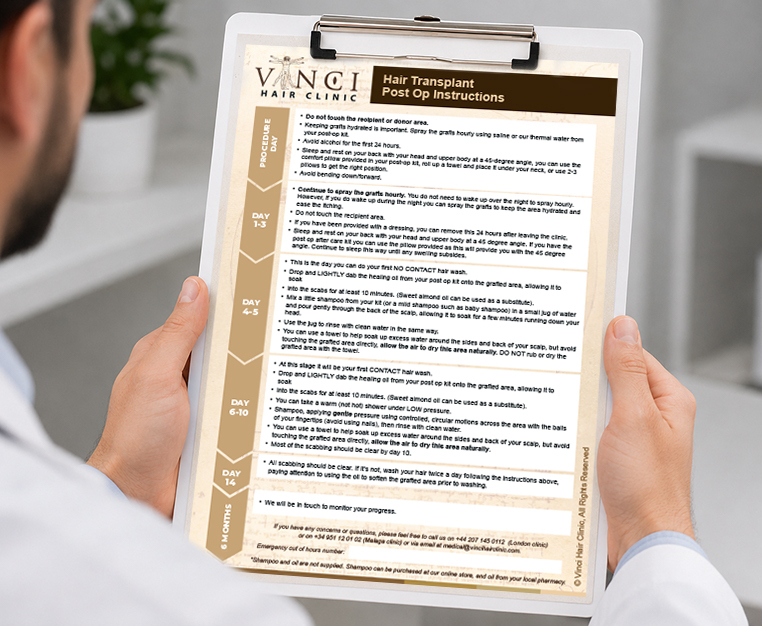
Across its more than 100,000 patients and 30 clinics, Vinci Hair Clinic has accumulated real-world outcome data that aligns with these clinical findings. Patients using the Vinci Laser Cap as part of a supervised programme report improvements in hair density and a reduction in progressive thinning when measured at six and twelve months. For those who have undergone a Vinci FUE hair transplant, LLLT serves an additional purpose: supporting the recovery of transplanted grafts and the surrounding native hair during the post-operative period. The Post-Op Kit offered by Vinci incorporates this thinking directly. [Vinci post-op hair transplant care]
Frequently Asked Questions
Q: How long does it take to see results from a laser cap?
A: Most patients begin to notice early signs of improvement between 16 and 26 weeks of consistent use, though individual timelines vary depending on the degree of hair loss, age, and whether the laser cap is being used alongside other treatments. Hair follicle cycles are slow by nature, and the photobiomodulation process works gradually to shift follicles from a resting phase back into active growth. Patience and regularity are the two most important factors. A baseline consultation with a trichologist before starting treatment allows for realistic expectations to be set and progress to be measured accurately.
Q: Is laser cap therapy safe for both men and women?
A: Yes, low-level laser therapy is considered safe for both male and female hair loss and has been studied in both populations. It is non-thermal at the energy levels used, meaning it does not heat tissue, and there are no reported systemic side effects associated with correctly specified devices used as directed. Women experiencing diffuse thinning often respond particularly well to LLLT, as their pattern of loss typically involves a large surface area of follicles in a weakened rather than absent state. As with any treatment, a consultation to confirm suitability is advisable before starting.
Q: Can I use a laser cap after a hair transplant?
A: LLLT can be a useful adjunct in the post-operative period following a hair transplant, and many hair restoration specialists incorporate it into post-op protocols for this reason. It is thought to support the energy demands of recovering grafts and may help maintain the condition of surrounding native hair during the months when shedding and regrowth are occurring. That said, timing and intensity should be guided by the surgical team: starting too soon or using an incorrect device in the immediate post-operative window is inadvisable. Vinci Hair Clinic addresses this directly through its dedicated Post-Op Kit and follow-up care programme.
Q: How often do you have to use a laser cap?
A: Most clinically studied protocols involve sessions of 20 to 30 minutes, used on alternating days, typically three to four times per week. This frequency allows for the necessary fluence to accumulate over time without delivering excessive energy to the scalp in a single sitting. The Vinci Laser Cap is designed to fit naturally into a daily routine, and the treatment schedule is simple enough to sustain long-term, which is important because ongoing use is required to maintain the benefits achieved. A Vinci trichologist will recommend the appropriate schedule as part of an individual treatment plan.
Q: Does a laser cap work for receding hairlines or only thinning on top?
A: LLLT tends to be most effective in areas where hair follicles are still present but weakened or in a dormant phase, rather than in areas of complete follicle loss. A deeply receded hairline where follicles have been absent for many years is unlikely to respond to laser therapy alone. For patients with recession alongside general thinning, a combined approach involving an FUE hair transplant to restore the hairline and LLLT to support overall density often produces the most clinically coherent outcome. Vinci Hair Clinic offers both, and a consultation with the specialist team is the best way to assess which combination is appropriate for each individual.
Speak to a Specialist at Vinci Hair Clinic
If you are considering the Vinci Laser Cap or want to understand how low-level laser therapy might fit into a broader plan for your hair health, the starting point is a consultation with one of Vinci’s trichologists or dermatologists. With clinics across more than 30 locations worldwide, including the Harley Street headquarters in London, an appointment is straightforward to arrange. A specialist will assess your pattern of loss, review your history, and recommend a course of action that is personalised rather than generic. You can book a consultation directly through the Vinci Hair Clinic website.


 UK Store